
The Identity Weather Report
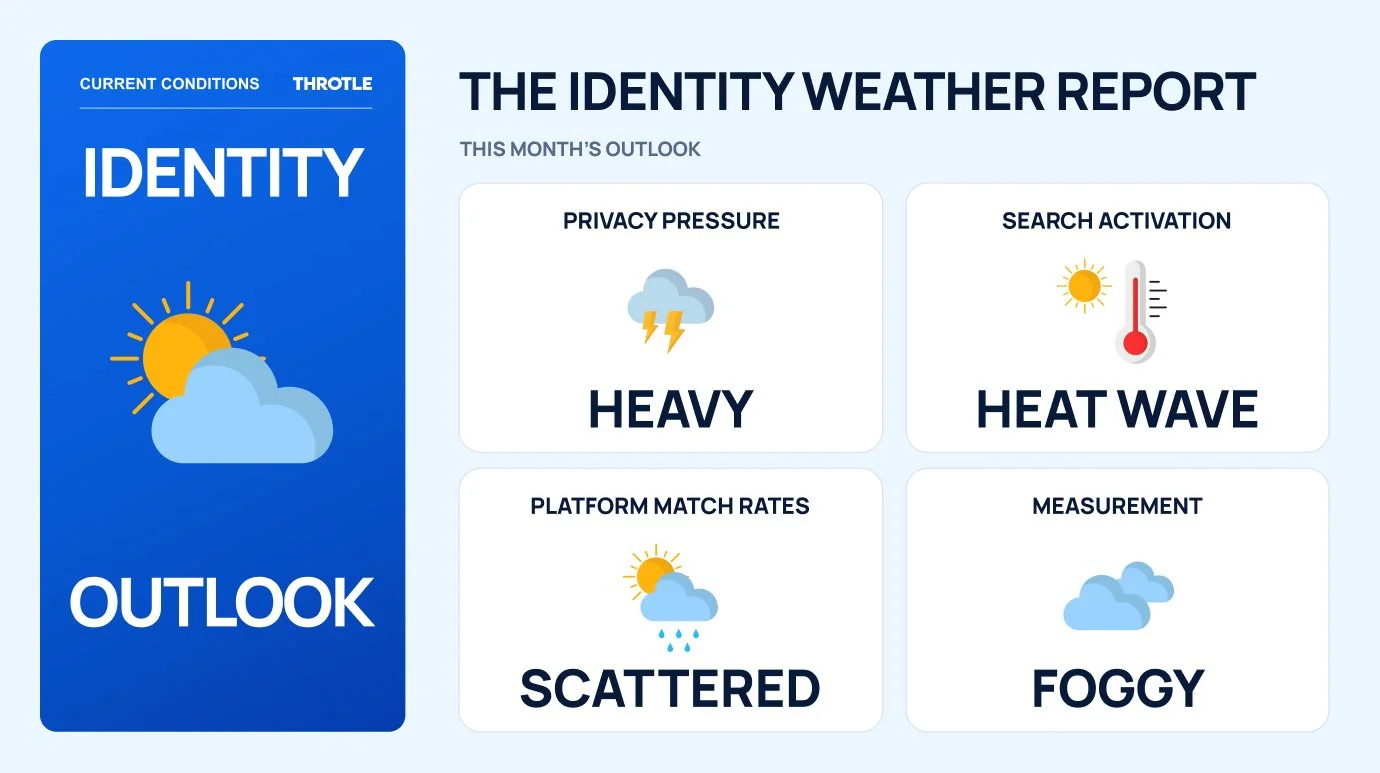
Grab your umbrella and your audience strategy. This month’s identity forecast calls for rising privacy pressure, a search activation heat wave, scattered platform match rates, and pockets of measurement fog. The good news? With transparent data, flexible activation, strong governance, and a clear understanding of how privacy requirements differ across use cases, healthcare marketers can stay ahead of changing conditions. Let’s see what’s moving across the radar.
This Month’s Outlook for Data-Driven Healthcare Marketers
Forecast: Increased Privacy Pressure
Regulatory clouds remain heavy as brands seek cleaner activation paths.
Privacy scrutiny continues to influence how healthcare marketers collect, connect, activate, and measure data. But not every healthcare audience carries the same privacy considerations. HCP targeting should be evaluated separately from consumer and patient targeting, where HIPAA requirements and state consumer-health-data laws may create a substantially higher compliance bar.
For consumer and patient use cases in particular, simply describing data as “permission-aware” may not be enough. Depending on the data, source, and intended use, HIPAA marketing authorization requirements or state consumer-health-data consent requirements may apply.
What it means for marketers: Data provenance and governance are becoming essential parts of campaign strategy. Before activating an audience, confirm that your partners can explain where the data originated, whether a covered entity was involved, what permissions or authorizations apply, and whether the same underlying record is permitted to be used for both activation and measurement.
Recommended gear: Transparent data provenance, use-case-specific privacy reviews, appropriate consent and authorization frameworks, and partners that can clearly document how data is sourced and used.
Forecast: Search Activation Heat Wave
Demand for HCP intent signals is heating up across Google and YouTube.
Healthcare professionals often turn to search and video when researching treatments, clinical developments, and patient-care decisions. These high-intent moments can help marketers reach relevant HCP audiences when interest is strongest.
Because HCP targeting presents a different risk profile from consumer or patient targeting, marketers should evaluate the data and activation approach based on the specific audience and use case rather than applying a single healthcare identity framework across both.
What it means for marketers: Search activation should be treated as more than a keyword strategy. Connecting verified HCP audience intelligence with search behavior can create more relevant engagement while helping campaigns move beyond broad contextual targeting. Marketers should still understand the provenance of those signals and how audience data is connected, shared, and activated.
Recommended gear: Verified HCP audiences, clearly documented data provenance, intent-informed segmentation, coordinated search and video activation, and thoughtful frequency controls.
Forecast: Platform Fragmentation Ahead
Expect inconsistent match rates across an increasingly fragmented media landscape.
Every platform has its own identity framework, audience requirements, and measurement methodology. The same audience may produce very different scale, match rates, and performance from one ecosystem to another.
At the same time, greater identity persistence is not automatically a solution to privacy pressure. Connecting an individual or household across platforms, channels, devices, and datasets can increase linkability and data-sharing risk, making governance around identity resolution increasingly important.
What it means for marketers: A single match-rate figure does not tell the whole story. Evaluate performance by platform, understand how each partner defines a match, and consider not only how identity improves reach but also how data is linked, shared, and governed throughout the process.
Recommended gear: Platform-specific benchmarks, flexible audience strategies, diversified activation paths, consistent measurement standards, and clear identity-governance practices.
Visibility Advisory: Measurement May Remain Hazy
Connecting media exposure to real-world outcomes requires additional visibility and scrutiny.
As identifiers become less consistent, marketers may encounter blind spots across channels and devices. But closing those gaps should not come at the expense of appropriate privacy controls.
In healthcare especially, linking advertising exposure to prescription lift, real world outcomes, or other real-world outcomes can represent one of the highest-risk uses of data. Tokenization and other privacy-enhancing technologies can reduce exposure of direct identifiers, but they do not by themselves resolve the legal or privacy considerations associated with linking advertising and health outcomes.
What it means for marketers: Establish both measurement expectations and privacy requirements before launch. Decide which outcomes matter, which data may appropriately be connected, whether the source data can legally support the intended measurement use, and what safeguards are required. Ask specifically whether the same record used for activation can also be used for measurement rather than assuming one permission covers both.
Recommended gear: Clearly defined KPIs, use-case-specific privacy review, documented data provenance, appropriate authorization or consent where required, privacy-enhancing technologies, and early alignment between media, data, analytics, legal, and privacy teams.
The Monthly Preparedness Checklist
Before your next campaign goes live:
Separate HCP targeting strategies from consumer and patient targeting strategies.
Review data provenance, permissions, authorizations, consent requirements, and governance.
Ask whether a covered entity was involved in the source of the data.
Confirm whether data approved for activation can also be used for measurement.
Benchmark expected match rates by platform.
Prioritize appropriate high-intent activation opportunities.
Build more than one route to your audience.
Evaluate the privacy implications of persistent cross-channel identity.
Apply additional scrutiny when connecting advertising exposure to Rx lift or other real-world outcomes.
Align identity, media, measurement, privacy, and legal teams before launch.
Test, learn, and adjust as conditions change.
The Outlook
The identity landscape will remain dynamic, and healthcare marketers will need to balance greater addressability with increasingly nuanced privacy requirements. The strongest strategies will not simply connect more signals; they will establish clear provenance, distinguish between HCP and consumer or patient use cases, apply appropriate permissions and authorizations, and carefully evaluate how identity is used across activation and measurement.
Marketers that build this discipline into campaign planning will be better prepared for whatever appears on the radar.
Need a clearer view of the identity landscape?
Throtle helps healthcare teams build identity programs around transparency, governance, and responsible data use, not simply more connections.
