
PHARMA FORWARD: A DHCG X Google Summit - Strengthening the Backbone of Digital Healthcare: Why Data Consistency Matters Now
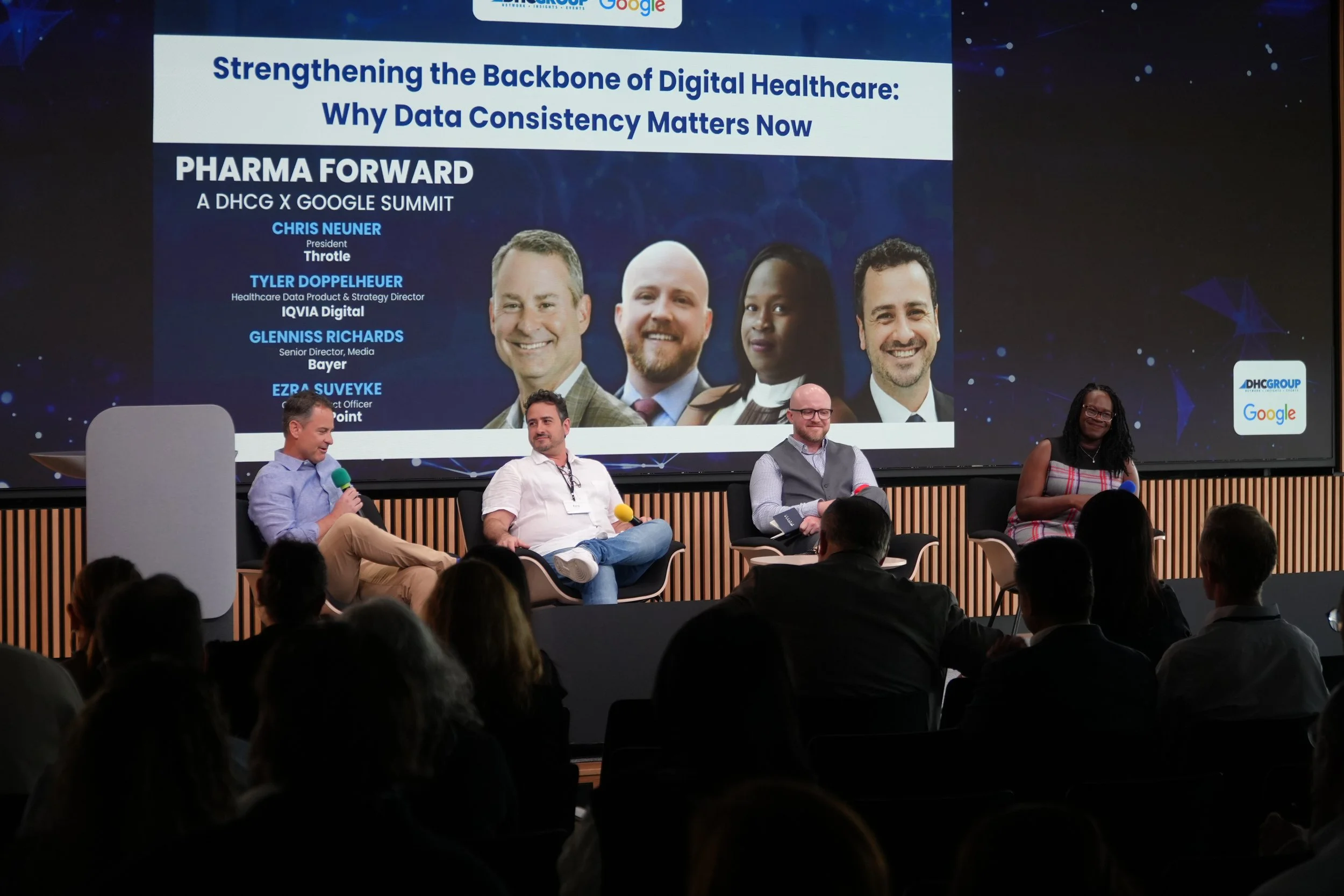
What the industry’s top data and media minds are saying and what it means for your next campaign
The foundation of every digital campaign in healthcare isn’t creative. It isn’t channel. It’s identity.
That was the throughline of a candid panel conversation that brought together senior voices from pharma media, health data, and ad tech — and the conversation was anything but consensus. Here’s what you need to know.
The Fragmentation Debate: Is It Really That Bad?
Yes, media and data are fragmented across devices, channels, and ID types, cookies, MAIDs, household IPs, shopper IDs, publisher-specific identifiers. Each one is a different interpretation of the same person. However, fragmentation is a symptom of not having the right partners, not a condition of the industry itself. When you have the right DSPs, the right CDPs, and data providers who are actively stitching signals together, the end user, the patient, the HCP, doesn’t feel that fragmentation. Neither should your campaign.
The counterpoint: the problems aren’t new. Data has been messy for 15 years. What’s changed is the expectation…AI has raised the bar for what “working well” looks like, which makes the gaps more visible and more costly.
The takeaway: Stop diagnosing fragmentation as an industry disease. Start auditing whether your stack is treating it.
Where Do You Start If You’re Building From Scratch?
The interoperability argument: If a data provider builds an audience using a consistent currency identifier, and that currency is accepted by the activation platform and the measurement platform, the tower of Babel collapses. The goal is a common language across the top publishers, DSPs, and data providers, not a universal fix for every vertical, but a focused agreement within healthcare’s ecosystem.
The data-first argument: Before you chase identifiers, align your underlying data. Know what your patient data actually contains, how it connects to claims, and what a CDP can do with it before you build any ID layer on top. Healthcare organizations, hospitals, pharma brands, payers, still operate in silos that no single identifier can solve if the data beneath it isn’t clean and consented.
The practical advice for anyone starting today: experiment. Test multiple vendors simultaneously. Expect to pick wrong ones. The fastest path to the right answer runs directly through a few wrong ones first.
Privacy Compliance: A Non-Negotiable and a Differentiator
Healthcare is not operating in the same regulatory environment as auto or CPG. HIPAA, My Health My Data, and a growing patchwork of state-level privacy laws create a distinct set of obligations and exposures. The standard that is set clearly: if a vendor can’t speak specifically to how they’re handling the 12+ emerging state privacy regulations, they are transferring their compliance risk directly to you. That’s not a negotiation point. That’s a disqualifier.
Leading data partners in this space have been doing tokenization, protecting patient identity before it ever enters the pipeline, for well over a decade. For newer entrants, it can feel daunting. But the panelists were clear: the complexity is exactly why your partners need to have already solved it, not be figuring it out alongside you.
One practical shift gaining traction: statistical modeling as a privacy-safe alternative to direct consumer targeting. It lifts campaigns above individual-level regulation risk while maintaining performance, a path worth exploring as state laws tighten.
And for any vendor that can’t have that conversation fluently? The answer from the brand side was simple: blacklisted.
What Does Getting It Right Actually Look Like?
When identity consistency works, when the data spine is solid, signals are persistent across a consumer’s journey, and measurement is aligned with what was actually targeted, the results feel almost improbable. Predictions land. Attribution holds. ROAS makes sense.
What breaks it: over-reliance on a single vendor strategy, ID discontinuity between campaign activation and measurement, and the ever-present threat of platform-level changes (zero-click search behavior, cookie deprecation, regulatory pivots) that strip context out from under your attribution model overnight.
The forward-looking framing from the panel: AI is accelerating everything, including the urgency to establish clean data portability processes now, before regulatory shifts force a reactive rebuild. The organizations that have their identity infrastructure in order won’t just be better at targeting. They’ll be more resilient when the rules change again.
Identity Resolution, the underpinning of the healthcare ecosystem
Identity resolution in healthcare isn’t a technical footnote. It’s the scaffolding under every audience, every activation, and every measurement outcome. Getting it right requires the right partners, the right internal discipline, and a willingness to experiment and fail forward.
The organizations winning today didn’t stumble into it. They built it deliberately and they protect it fiercely.
